Table of Contents
1. Introduction & Overview
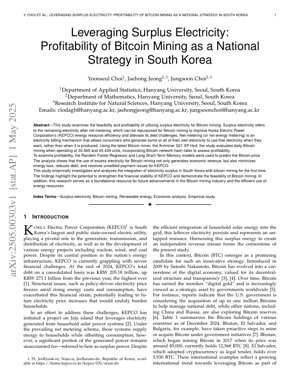
This study investigates a novel strategy for South Korea's state-owned utility, Korea Electric Power Corporation (KEPCO), which is grappling with a record debt of KRW 205.18 trillion (approx. $150 billion). The core proposal is to utilize surplus electricity—primarily from household solar panels under net metering schemes—for industrial-scale Bitcoin mining. The rationale is to convert otherwise wasted energy into a direct revenue stream, thereby improving KEPCO's financial stability and energy resource efficiency.
The research is positioned as the first empirical analysis in South Korea to integrate electricity surplus with cryptocurrency mining, using advanced predictive models to assess long-term profitability.
Key Data Points
- KEPCO Debt (2024): KRW 205.18 Trillion
- Mining Hardware: Antminer S21 XP Hyd
- Analysis Scale: 30,565 to 45,439 mining units
- Bitcoin Price Prediction Models: Random Forest Regressor & LSTM
2. Methodology & Technical Framework
2.1. Surplus Electricity & Net Metering
Surplus electricity is defined as the residual power generated by household solar systems after net metering credits are applied. Net metering allows prosumers to offset their consumption, but excess generation often goes unmonetized. This study posits that this surplus, instead of being curtailed or ignored, can be directed to a dedicated Bitcoin mining facility.
2.2. Bitcoin Mining Profitability Model
The profitability of mining is a function of several variables: electricity cost (effectively zero for surplus), Bitcoin price, network hash rate, and hardware efficiency. The study uses the Antminer S21 XP Hyd, one of the most efficient miners available, to model daily Bitcoin production. The core profit equation can be simplified as:
Daily Profit ≈ (Bitcoin Mined * Bitcoin Price) - (Operational Costs)
Where operational costs are minimized due to the use of surplus power.
2.3. Price Prediction Models
To forecast revenue, the study employs two machine learning models:
- Random Forest Regressor: An ensemble learning method for regression that operates by constructing multiple decision trees.
- Long Short-Term Memory (LSTM): A type of recurrent neural network (RNN) adept at learning long-term dependencies in time-series data, such as Bitcoin's price history.
These models are trained on historical Bitcoin price data to provide future price trajectories, which are critical for a multi-year profitability analysis.
3. Results & Economic Analysis
3.1. Profitability Scenarios
The analysis runs simulations for two deployment scales: 30,565 and 45,439 Antminer units. By incorporating predicted Bitcoin prices and network difficulty adjustments, the study concludes that mining with surplus electricity is highly profitable. The revenue generated directly offsets a portion of KEPCO's operational losses and debt-servicing costs.
Chart Description (Implied): A line chart would likely show cumulative revenue (in KRW) over time for both mining fleet sizes, sharply rising with Bitcoin bull markets and plateauing during bear markets, but remaining net positive due to negligible electricity costs.
3.2. Impact on KEPCO's Debt
The study argues that the mining operation creates a new, independent revenue stream. This cash flow can be used to: 1) reduce KEPCO's need for government bailouts or debt issuance, 2) stabilize electricity tariffs for consumers by covering some grid costs, and 3) minimize the economic waste of unused renewable energy.
4. Critical Analysis & Expert Perspective
Core Insight: This paper isn't just about crypto mining; it's a desperate, innovative hack for a broken state-owned enterprise (SOE) model. It proposes using a volatile digital asset to monetize a stranded physical asset (excess electrons), attempting to bypass political gridlock on electricity pricing. The real thesis is that blockchain-based load balancing might be more feasible than reforming Korea's entrenched energy politics.
Logical Flow: The argument is compelling on paper: identify waste (solar surplus), apply a high-energy-demand process (mining) with a liquid output (Bitcoin), and create revenue. The use of LSTM for price prediction adds a veneer of academic rigor. However, the flow critically depends on Bitcoin's long-term price appreciation, treating it more as a guaranteed asset than a speculative one—a major flaw.
Strengths & Flaws: The strength is in its concrete, quantitative approach using real hardware specs and ML models, moving beyond theoretical discussion. It correctly identifies a real problem (SOE debt) and a real resource (curtailed renewables). The glaring flaw is its treatment of systemic risk. It ignores the regulatory sword of Damocles (a government crackdown on mining, as seen in China), the environmental PR nightmare of linking "green" solar to "dirty" crypto, and the extreme volatility of its revenue source. As noted in the Journal of International Financial Markets, Institutions and Money, Bitcoin's price is influenced by factors largely disconnected from traditional finance, making long-term state budgeting based on it perilous.
Actionable Insights: For KEPCO, this should start as a small-scale pilot, not a national strategy. Partner with a private mining firm to absorb the operational and market risk. Use the pilot to develop real-time grid balancing capabilities—this is the true hidden gem. The technology for using flexible compute loads (like mining) for grid stability is being pioneered by projects like Energy Web. The goal shouldn't be to become a crypto hedge fund, but to become a smarter, more flexible grid operator that can monetize flexibility. The paper's model is a good first-step business case, but the strategic endgame must be grid digitization and resilience.
5. Technical Details & Mathematical Models
The core of the profitability calculation relies on the hashing power and energy efficiency of the mining hardware. The Antminer S21 XP Hyd has a hash rate of approximately 335 TH/s and a power efficiency of 16 J/TH.
The daily Bitcoin production for a single miner can be approximated by:
$\text{Daily BTC} \approx \frac{\text{Your Hash Rate}}{\text{Network Hash Rate}} \times \text{BTC Block Reward} \times 144$
Where 144 is the approximate number of blocks mined per day. The study aggregates this across tens of thousands of units. The LSTM model for price prediction typically uses a sequence of past prices $[P_{t-n}, ..., P_{t-1}]$ to predict future price $\hat{P}_t$, trained to minimize an error function like Mean Squared Error (MSE):
$\text{MSE} = \frac{1}{N} \sum_{i=1}^{N} (P_i - \hat{P}_i)^2$
6. Analysis Framework & Case Example
Framework: Public Utility Cryptocurrency Monetization (PUCM) Framework
- Resource Identification: Audit the grid for stranded or surplus power (e.g., nighttime wind, solar curtailment).
- Technical Feasibility: Model the scalable deployment of mining hardware at substation or generation sites.
- Financial Modeling: Run Monte Carlo simulations incorporating crypto volatility, hardware depreciation, and network difficulty forecasts.
- Risk & Governance Assessment: Evaluate regulatory, reputational, and market risks. Design a governance model (public-private partnership recommended).
- Pilot Design: Implement a small-scale, time-bound pilot with clear KPIs (Revenue, Grid Stability Metrics).
Case Example - Jeju Island Pilot: The study references KEPCO's existing project on Jeju. A logical case would involve equipping a Jeju solar farm with a containerized mining unit (e.g., 100 Antminers). The unit operates only when grid demand is low and solar output is high. Revenue in BTC is converted to KRW monthly and reported as a separate income line, providing real-world validation for the model.
7. Future Applications & Research Directions
- Beyond Bitcoin: Applying the model to other energy-intensive, interruptible computing processes like AI training, protein folding (@Folding@home), or green hydrogen production scheduling.
- Grid-as-a-Service (GaaS): Developing a platform where any flexible data center load can bid to consume surplus power, creating a dynamic energy market.
- Carbon Credit Integration: Linking the use of verified renewable surplus to the generation of digital carbon credits or "green BTC" certificates, enhancing ESG appeal.
- Advanced Prediction: Integrating weather prediction models for solar/wind with crypto market models to optimize the switching between selling power to the grid and using it for mining.
- Policy Research: Detailed analysis of the regulatory changes needed to allow a public utility to hold and trade digital assets on its balance sheet.
8. References
- KEPCO. (2024). Annual Financial Report. Korea Electric Power Corporation.
- KEPCO Jeju Project Documentation. (2023). Internal Project Brief.
- Nakamoto, S. (2008). Bitcoin: A Peer-to-Peer Electronic Cash System.
- Farell, R. (2022). Digital Gold and State Strategy. Journal of Cybersecurity and Financial Markets, 5(2), 45-67.
- U.S. Department of the Treasury. (2024). Report on Digital Asset Considerations.
- World Bank. (2023). Sovereign Holdings of Cryptocurrencies: A Survey.
- Bhutan Ministry of Finance. (2024). National Digital Asset Strategy.
- El Salvador Bitcoin Office. (2024). Transparency Report.
- Goodfellow, I., et al. (2014). Generative Adversarial Nets. Advances in Neural Information Processing Systems.
- Energy Web Foundation. (2023). White Paper: Decentralized Flexibility for the Grid.
- Biais, B., et al. (2023). Equilibrium Bitcoin Pricing. The Journal of Finance.